
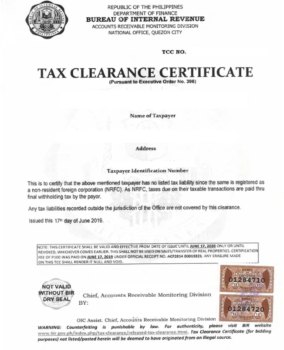
In the Philippines, a tax clearance is more than a piece of paper. It is proof that a taxpayer has no disqualifying outstanding obligations with the Bureau of Internal Revenue (BIR) and is often required in government procurement, business closures, and other regulated transactions. For companies partnering with Triple i Consulting, understanding tax clearance requirements is essential because the clearance can affect contract eligibility, licensing timelines, and even exit planning.pwc+1
A tax clearance may be requested by businesses bidding on public projects, corporations closing or restructuring operations, and taxpayers needing proof of compliance for specific transactions. The exact requirements depend on the purpose of the clearance, but the common thread is the same: the BIR must be satisfied that the applicant has settled its tax obligations and has no disqualifying delinquency or open tax cases.
What a Tax Clearance Does
A tax clearance functions as a formal certification from the BIR that the taxpayer is compliant with its tax obligations, at least for the purpose for which the clearance is issued. In procurement settings, it may serve as proof that a bidder is eligible to participate in a government contract. In other settings, such as business closure or restructuring, it helps show that the company has resolved its tax account before ending or changing operations.
The clearance is not just administrative convenience. It can be a gatekeeping document that determines whether a business may proceed with a transaction or be disqualified from it. For that reason, companies should treat the clearance as part of a broader compliance strategy rather than a last-minute requirement.
When It Is Required
The need for a tax clearance depends on the transaction. One common use is government bidding or procurement, where taxpayers participating in public contracts must show tax compliance. The BIR’s online eTCBP-TCVC system specifically exists for Tax Clearance for Bidding Purposes and Tax Compliance Verification Certificates.
A tax clearance may also be needed for:
- Business closure or cessation.
- Contracting with the government.
- Certain licensing or regulatory processes.
- Other transactions where the receiving agency requires proof of tax compliance.
The BIR and other authorities use this requirement as part of due diligence to reduce public risk and ensure that public contractors are current in their tax obligations. If the taxpayer is in the middle of a transaction that depends on the clearance, delays can create real business consequences.
General Tax Clearance Requirements
The central tax clearance requirements revolve around proving tax compliance, no delinquency, and a correct filing history. While the exact list can vary by the purpose of the clearance and the taxpayer’s category, the following are common documentary and compliance requirements:
- A duly accomplished application form for tax clearance.
- A written request or formal application addressed to the appropriate BIR office.
- The taxpayer’s Certificate of Registration (BIR Form 2303), where applicable.
- Proof of filed and paid tax returns, including income tax returns and business tax returns.
- Proof of payment of outstanding tax liabilities, if any.
- A Certificate of No Tax Liability or equivalent showing that the taxpayer has no unpaid obligations, when applicable.Supporting financial and registration documents required by the BIR office handling the application.
For government bidding applications, the BIR’s eTCBP-TCVC system is the formal online channel for submission. Applicants should expect to provide tax return history and compliance records that allow the BIR to verify whether the taxpayer is in good standing.
Filing Conditions and Eligibility
The BIR imposes eligibility rules before issuing a clearance. For renewal or regular tax clearance applicants, the taxpayer generally needs to be a regular eFPS user or otherwise submit the correct manual or non-eFPS records, depending on the category. New applicants may have a slightly different documentary path because they may not yet have a full filing history through the eFPS system.
According to the BIR guidance summarized in the source materials:
- The applicant must not be tagged as “Cannot Be Located.”
- The applicant must have no unpaid annual registration fee.
- The applicant must have no open valid “stop-filer” cases.
- The applicant must have no accounts receivable or delinquent accounts.
- The applicant must have no pending criminal information filed in any court for tax or tax-related cases.
These requirements are meant to confirm not only that the taxpayer has paid what it owes, but also that it is traceable, active, and free from unresolved enforcement issues. In practical terms, a company with unresolved tax cases or a missing registration status should address those issues before applying.
Application Routes and Offices
The filing route depends on the taxpayer type and registration status. Non-large taxpayers generally file with the Collection Division of the Revenue Regional Office that has jurisdiction over them. Large taxpayers file with the Large Taxpayers Division or the appropriate Large Taxpayers Enforcement Division, depending on their registration status.
For non-resident aliens not engaged in trade or business, non-resident foreign corporations, and other entities authorized by the Commissioner, the application may still be filed with the Accounts Receivable Monitoring Division. That makes it important for foreign businesses and cross-border taxpayers to identify the proper filing office before preparing their documents.
The BIR also offers the eTCBP-TCVC system for electronic submission of Tax Clearance for Bidding Purposes and Tax Compliance Verification Certificate applications. That system is especially relevant for taxpayers who need a clearance connected to government contracting and procurement.
Documentary Proof for Business Applicants
For business applicants, the tax clearance requirements often focus on proving filing history and settled liabilities. The following documents are commonly needed:filepino+1
- Latest income tax return.
- Latest value-added tax or percentage tax returns.
- Proof of payment for the tax returns filed.
- BIR registration documents.
- Audited financial statements, where required by the taxpayer’s structure or transaction purpose.
- Any BIR-issued certificate confirming no tax liability or equivalent compliance status.
For new establishments or those operating for less than six months, the BIR may require the latest quarterly or monthly returns available to date, rather than a full prior-year set. That is an important distinction for startups, newly registered branches, and fast-growing businesses.
Documentary Proof for Government Bidding
When the purpose is bidding or contracting with the government, the application is more specific. The BIR’s process for tax clearance for bidding purposes is linked to the eTCBP-TCVC platform. This certificate is intended to confirm that a bidder is compliant and eligible to participate in public procurement or related government transactions.
In this context, businesses should prepare:
- Application details for the Tax Clearance for Bidding Purposes or TCVC.
- Evidence of up-to-date tax filings.
- Proof that no delinquent tax account exists.
- Any specific agency documents required by the procuring entity.
Because public contracting depends on timely compliance, the clearance should be treated as part of the bid preparation calendar rather than a post-submission document. Delaying the clearance can cause the entire proposal to fail.
Processing Time and Validity
The BIR guidance cited in the source material indicates that a tax clearance should be processed and released within two working days from receipt of a complete application with all required documents. That is relatively quick, but only if the submission is complete and the applicant satisfies the eligibility criteria.
Once issued, the tax clearance is generally valid for one year from the date of issuance, unless revoked sooner for specified reasons. Revocation may occur if the applicant’s documents are found to be spurious, if the applicant no longer meets the required criteria, or if misrepresentations were made in the application. This means the certificate is valuable, but not permanent; taxpayers must maintain compliance after issuance.
Common Problems and Risks
Businesses often run into avoidable problems when dealing with tax clearance requirements. One common issue is incomplete tax filing history, especially when older returns or payment confirmations are missing. Another is the presence of unresolved delinquent accounts, penalties, or stop-filer cases that were not cleared before filing.
Some applicants also submit the wrong application to the wrong BIR office, which delays processing. Others assume that having no immediate tax arrears is enough, even though the BIR also checks registration status, pending cases, and the overall completeness of compliance. These problems can often be fixed, but they usually take longer than expected.
For businesses entering public procurement, the risk is more severe because a missing or invalid clearance can disqualify a bid. That can mean losing a contract opportunity even if the commercial proposal is otherwise strong.
Key Takeaways
The main lesson from the BIR’s tax clearance rules is simple: compliance is both a legal condition and a transaction tool. Whether the goal is government bidding, business closure, or another regulated transaction, the taxpayer must prove that it has no unresolved tax liabilities and that its filings are up to date. This is why tax clearance requirements should be managed continuously, not only when a clearance is urgently needed.
For Philippine businesses, the best approach is to maintain clean records, monitor tax liabilities throughout the year, and resolve issues before they become blockers. A proactive process saves time, lowers risk, and protects business opportunities that may depend on a valid clearance.
Is Assistance Available?
Yes. Triple i Consulting can help you review, prepare, and organize the documents needed to meet tax clearance requirements in the Philippines. We assist businesses with compliance review, tax filing reconciliation, and BIR process coordination so the clearance application can move forward smoothly. Contact us today to schedule an initial consultation with one of our tax and compliance specialists:
- Contact Us Here
- Fill out the form below
- Call us at: +63 (02) 8540-9623
- Send an email to: info@tripleiconsulting.com